Briefing trainee scheme pattern
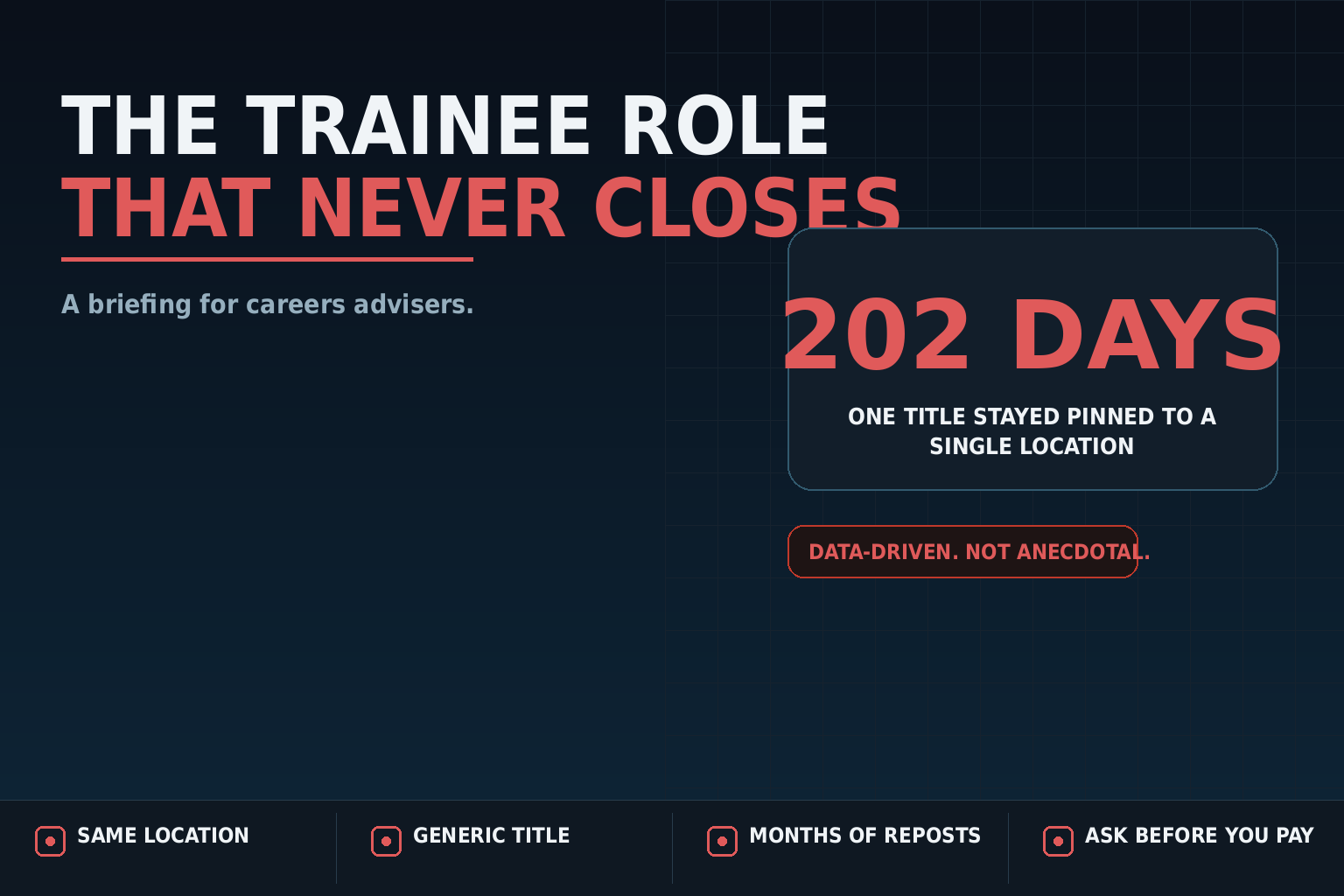
Briefing: the "perpetually open" trainee role, and why your students should know about it
A briefing for advisers:
the trainee role that never closes
What the pattern looks like in the data
A small set of advertisers show posting behaviour structurally distinct from ordinary employers: the same generic entry-level title, from a single location, repeated dozens to well over a hundred times across many months — often alongside several other similarly generic "trainee" titles from the same poster. Genuine multi-site employers show a very different shape: the same title, spread across many different locations, tracking real branch-level hiring.
💬 Ask directly, in writing
Is there a job at the end, or a course first? What does it cost, and when is payment due relative to any placement guarantee?
🔎 Research the scheme name
Search the specific programme title alongside "review" or "complaint," not just the company name, and read critically.
⚠️ Scrutinise "guaranteed" claims
Legitimate providers are generally cautious about absolute guarantees. Heavy "guaranteed job" language deserves a second look.
🎯 A good coaching question, not an accusation
"This exact title has been live in some form for six months — what does that suggest about how they're operating?" Flag the pattern as a conversation starter, not a verdict. Some of these programmes are genuine and do lead to real outcomes.
Career-changers and new graduates are the group most likely to encounter these schemes, and least likely to have the pattern-recognition built up from experience. A five-minute briefing during a careers workshop gives students a concrete, checkable heuristic rather than a vague warning to "be careful."
Give students a checkable heuristic
We're building automated detection for this exact pattern at GetJobzi, so advisers and students can check a poster's history before engaging.
👉 GetJobzi.com — Talk to us